In a decisive move to prevent corruption and protect taxpayer interests, the Securities and Exchange Commission (SEC) has proposed a major overhaul of accreditation guidelines for auditing firms. This proposal, released for public comment on April 1, 2026, specifically targets the financial oversight of large-scale government projects following recent high-profile scandals involving “ghost projects” and fund mismanagement.
Targeting High-Value Government Contracts
The key provision of the proposed amendment to the Revised Rule 68 of the Securities Regulation Code (SRC) is the expansion of SEC oversight to private corporations managing significant government projects.
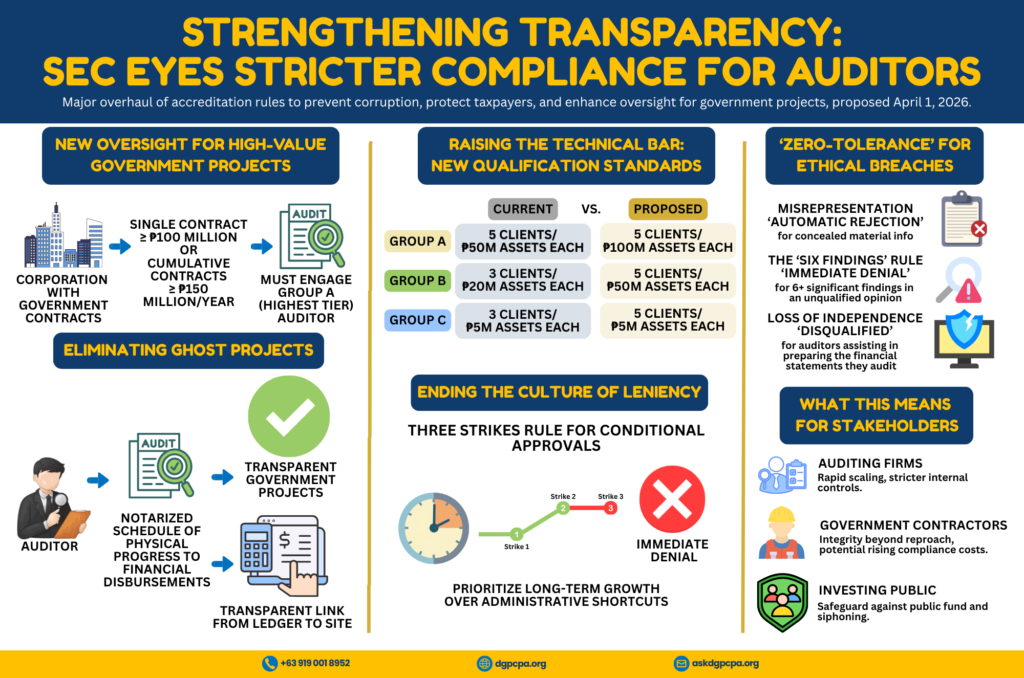
Under the new rules, any corporation awarded a single government contract of at least ₱100 million, or cumulative contracts totaling ₱150 million within a year, is no longer permitted to use standard auditors. They must engage a Group A SEC-accredited external auditor—the highest tier of certification—for the entire duration of the project.
To eliminate the risk of “ghost projects,” these auditors must verify a notarized schedule for each project. This report serves as a mechanical check to ensure that financial disbursements are backed by actual, physical progress on the ground, creating a transparent link between the ledger and the construction site.
Raising the Technical Bar: New Qualification Standards
The SEC is proposing to tighten the track record requirements for all accreditation categories. These changes ensure that firms have the technical scale and historical experience to handle increasingly complex corporate structures and massive government portfolios.
| Category | Proposed Requirement | Current Requirement |
| Group A | 5 clients with total assets of ₱100M each | 5 clients with total assets of ₱50M each |
| Group B | 5 clients with total assets of ₱50M each | 3 clients with total assets of ₱20M each |
| Group C | 5 clients with total assets of ₱5M each | 3 clients with total assets of ₱5M each |
Ending the “Culture of Leniency”
The Commission is introducing a “Three Strikes” rule for conditional approvals. Historically, firms that fell slightly short of full requirements could rely on recurring grace periods. The proposed guidelines limit these “conditional” passes to a maximum of three instances per category. Once a firm hits this limit, further failure to meet baseline requirements results in immediate denial, forcing firms to prioritize long term technical growth over administrative shortcuts.
“Zero-Tolerance” for Ethical Breaches
The SEC has also defined non-negotiable grounds for summary disqualification to ensure that accreditation is viewed as a badge of ethical and technical expertise:
- Misrepresentation: Applications will be automatically rejected for any concealment of material information during the evaluation of the financial statements.
- The “Six Findings” Rule: If six or more significant material findings are discovered in financial statements for which the auditor previously issued an unqualified opinion, the auditor shall face immediate denial.
- Loss of Independence: Auditors found assisting in the preparation of the very financial documents they were hired to audit will be disqualified, preserving the essential “arms-length” relationship required for a valid audit.
What This Means for Stakeholders
For auditing firms, these changes signal a need for rapid scaling and stricter internal quality controls. For government contractors, compliance costs may rise, but the mandate ensures their financial integrity is beyond reproach. Ultimately, for the investing public, these measures act as a safeguard against the siphoning of public funds.
DISCLAIMER
The information provided herein is intended for general informational purposes only and reflects the current understanding of the given topic. It is subject to change in response to updates in laws or regulations. This material does not constitute legal or financial advice. For tailored advice, please contact De Guzman Pascual and Associates CPAs at ask@dgpcpa.org. The views expressed do not necessarily represent any official position of governmental or financial entities.